Hotline2 405 505

News

Tuesday, 24 September, 2024
Share

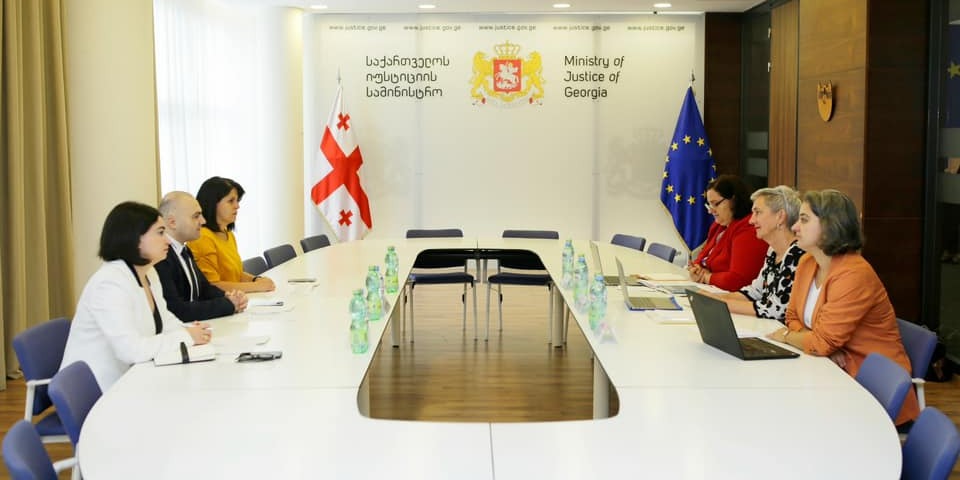
Ministry of Justice of Georgia Hosts the Group of Experts on Combating Human Trafficking (GRETA)

Deputy Minister of Justice, Beka Dzamashvili, held a meeting with the delegation from the Group of Experts on Action against Trafficking in Human Beings (GRETA).

During the meeting, the Deputy Minister emphasized that combating human trafficking remains a key priority for the Georgian government. He highlighted that the country continuously implements measures in line with international standards, as demonstrated by several international assessments. Georgia consistently ranks alongside EU member states in terms of its efforts to fight human trafficking.

Notably, according to the 2024 U.S. State Department report on human trafficking, Georgia remains in the top tier of countries for the ninth consecutive year. Among 186 countries worldwide, Georgia is ranked at the highest level for its actions against human trafficking. This year, only 33 countries achieved this top-tier status.

Additionally, the Deputy Minister referenced the 2023 report from the Walk Free Foundation, which assesses the Global Slavery Index. The report ranked Georgia 14th out of 160 countries for its proactive steps in addressing human trafficking.

Dzamashvili reiterated the government’s commitment to continuing its efforts in combating trafficking, noting that the recommendations of GRETA would be fully considered moving forward.

This marks the fourth visit of a GRETA delegation to Georgia. The independent and impartial group of experts is responsible for evaluating how states comply with the Council of Europe Convention on Action against Trafficking in Human Beings.

During their visit, the GRETA delegation will also meet with representatives from other government agencies, the Parliament of Georgia, the Public Defender’s Office, the judiciary, and various local and international non-governmental organizations.

Other News

Share
Print

The Grand Chamber of the Strasbourg Court Delivers a Judgement on the Cases of the June 20-21, 2019 Demonstrations

The Grand Chamber of the European Court of Human Rights delivered its judgment in the case Tsaava and Others v. Georgia at a public hearing today, 11 December 2025. The case concerns the demonstrations of 20–21 June 2019 and the use of special means to disperse the protesters.

In its judgment, the Grand Chamber reaffirmed that the state has the legitimate right to resort to special means in situations involving attacks or assaults on law enforcement officers and state institutions. The Court also noted that the escalation of the June 20 events and the assault on the Parliament building were encouraged by opposition politicians.

The Court held that the use of force and special means should have been directed exclusively at demonstrators who engaged in violent actions. As the leadership of the Ministry of Internal Affairs at the time failed to ensure adherence to this standard and did not guarantee the proportional use of force, the Court found a violation of Articles 3 (prohibition of ill-treatment), 10 (freedom of expression), and 11 (freedom of assembly) of the European Convention on Human Rights.

The Grand Chamber further noted that the Government of Georgia fully cooperated with the Court during the proceedings and provided all necessary information and materials. Consequently, the applicants’ complaint alleging a lack of cooperation was dismissed. The Court did not find it necessary to examine the complaint under Article 13 (right to an effective remedy).

Following the shortcomings identified in the Chamber’s judgment of 7 May 2024, the government initiated an investigation into the planning and execution of the MIA operation to determine its compliance with the standards established by the European Court.

As a result of this investigation, on 12 November 2025, the Prosecutor’s Office of Georgia initiated criminal proceedings against the former Minister of Internal Affairs, Giorgi Gakharia. The investigation is ongoing.