Hotline2 405 505

News

Thursday, 18 January, 2024
Share

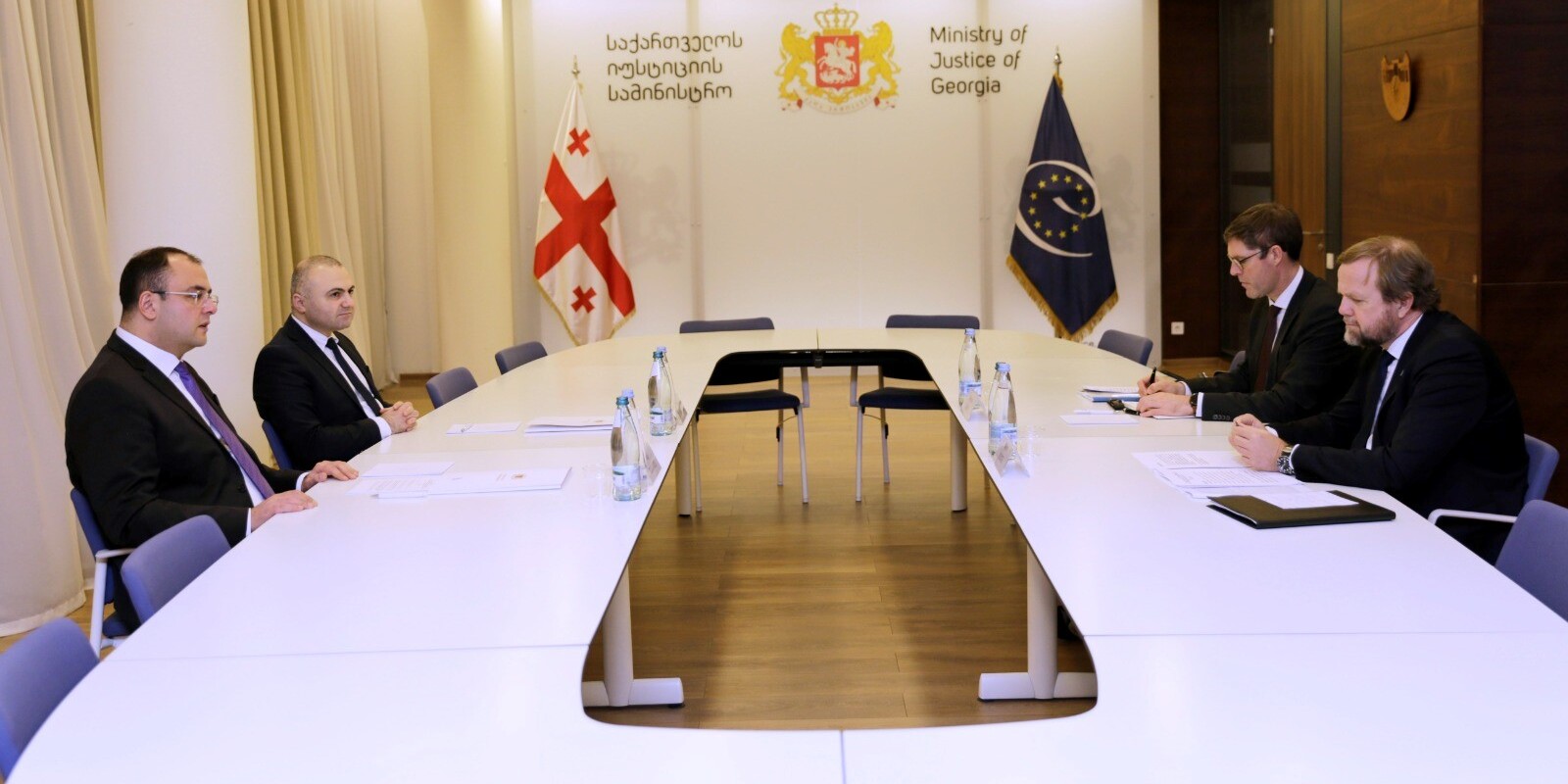
Minister of Justice Meets Deputy Secretary General of the Council of Europe to Discuss the Progress Achieved in the Field of Human Rights Protection

Rati Bregadze and Bjorn Berge discussed today the results of reforms of the justice and penitentiary systems.

The Minister of Justice noted the progress achieved by Georgia, which is demonstrated by the statistics of cases submitted to the European Court of Human Rights from Georgia. In particular, according to the data of January 2023, the European Court received 147 applications from Georgia, which represents a historical minimum. For comparison, by 2011, Strasbourg received 3045 cases against Georgia.

Special attention was paid to the legal status of prisoners. The Minister of Justice emphasized the fact that the systemic problem of inhuman treatment and torture has been completely eliminated in Georgian prisons, which is confirmed by a number of international authoritative organizations, including the European Committee for the Prevention of Torture and Inhuman or Degrading Treatment or Punishment (CPT). It was noted that since 2012, the European Court of Human Rights has not received any lawsuits from Georgian prisons.

The parties discussed the new penitentiary code, the Digital University, projects for rehabilitation and re-socialization of prisoners, the strategy of replacing large open penitentiary institutions with small-scale prisons, etc.

The importance of the implementation of decisions made by the Strasbourg Court in interstate cases was noted, according to which the responsibility for massive human rights violations during the August 2008 war rests with the Russian Federation.

The importance of effective cooperation with the Council of Europe in the process of Georgia's integration into the European Union was emphasized.

Deputy Minister of Justice, Beka Dzamashvili also attended the meeting.

Other News

Share
Print

The Grand Chamber of the Strasbourg Court Delivers a Judgement on the Cases of the June 20-21, 2019 Demonstrations

The Grand Chamber of the European Court of Human Rights delivered its judgment in the case Tsaava and Others v. Georgia at a public hearing today, 11 December 2025. The case concerns the demonstrations of 20–21 June 2019 and the use of special means to disperse the protesters.

In its judgment, the Grand Chamber reaffirmed that the state has the legitimate right to resort to special means in situations involving attacks or assaults on law enforcement officers and state institutions. The Court also noted that the escalation of the June 20 events and the assault on the Parliament building were encouraged by opposition politicians.

The Court held that the use of force and special means should have been directed exclusively at demonstrators who engaged in violent actions. As the leadership of the Ministry of Internal Affairs at the time failed to ensure adherence to this standard and did not guarantee the proportional use of force, the Court found a violation of Articles 3 (prohibition of ill-treatment), 10 (freedom of expression), and 11 (freedom of assembly) of the European Convention on Human Rights.

The Grand Chamber further noted that the Government of Georgia fully cooperated with the Court during the proceedings and provided all necessary information and materials. Consequently, the applicants’ complaint alleging a lack of cooperation was dismissed. The Court did not find it necessary to examine the complaint under Article 13 (right to an effective remedy).

Following the shortcomings identified in the Chamber’s judgment of 7 May 2024, the government initiated an investigation into the planning and execution of the MIA operation to determine its compliance with the standards established by the European Court.

As a result of this investigation, on 12 November 2025, the Prosecutor’s Office of Georgia initiated criminal proceedings against the former Minister of Internal Affairs, Giorgi Gakharia. The investigation is ongoing.