 Geo
Geo Eng
EngNews
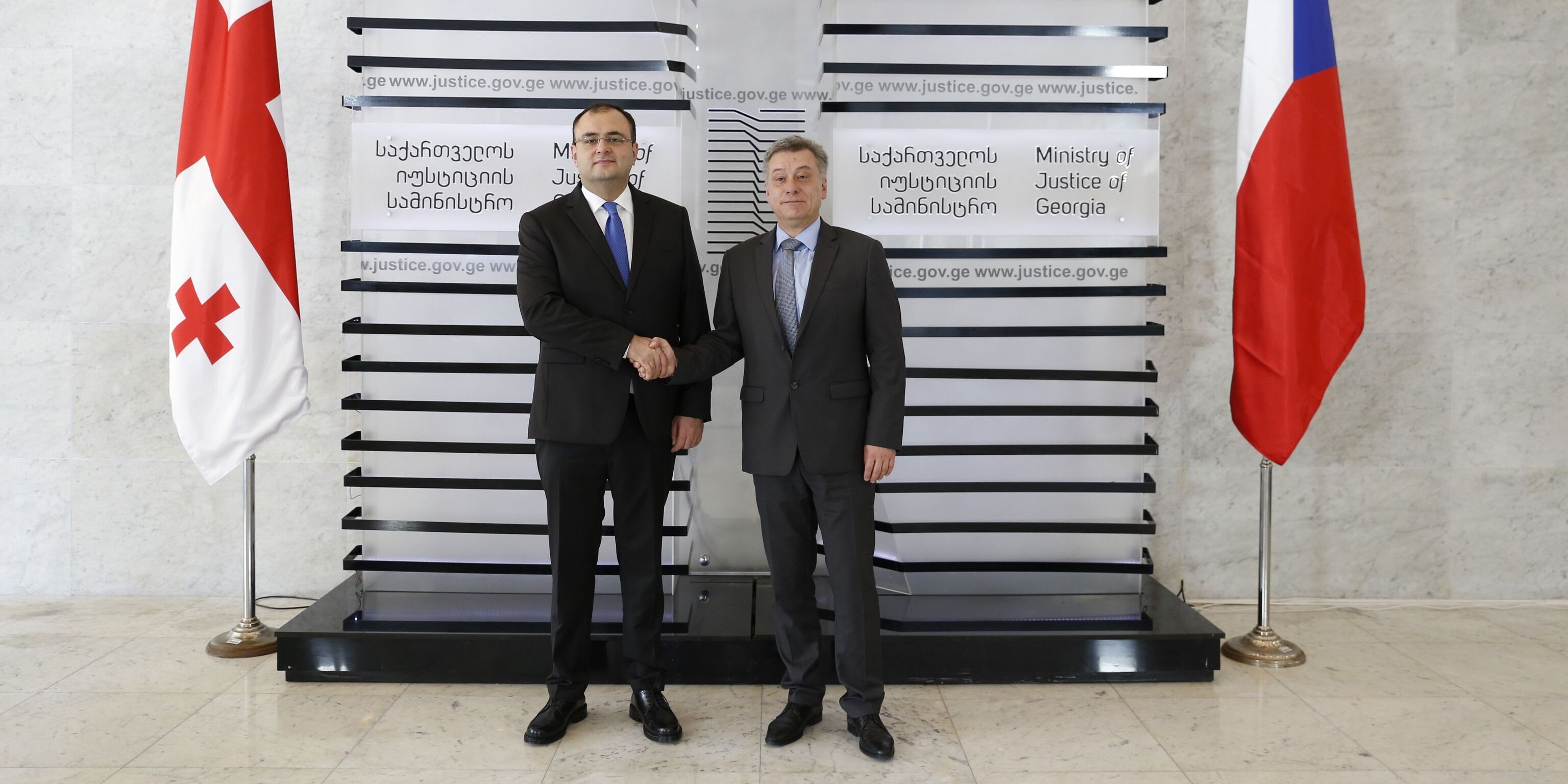
Ministries of Justice of Georgia and the Czech Republic Sign Joint Declaration
A joint declaration was signed today between the Ministries of Justice of Georgia and the Czech Republic.
The cooperation between the ministries of justice of Georgia and the Czech Republic, which started within the framework of the ministerial meeting organized by the Council of the European Union in Prague, continued today with the signing of a joint declaration. The Georgian Minister of Justice met today with the delegation of the Czech Ministry of Justice. The cooperation document was signed by Rati Bregadze and his Czech colleague, Pavel Blažek.
The document includes cooperation in the field of justice reform and support for digital governance; as well as: promoting the process of convergence with the EU legislation; effective management of penitentiary, probation and crime prevention systems; and strengthening legal mutual assistance and other directions.
Rati Bregadze noted that it is important for the Ministry of Justice to establish bilateral relations with partners in such priority directions as: strengthening approaches based on the protection of human rights, continuing reforms in the system of the Ministry of Justice, digitalization of state services, increasing accessibility and progress of electronic governance.
The Minister of Justice thanked his Czech counterpart for his continuous support for the process of Georgia's integration into the European Union and its territorial integrity. According to him, the strengthening of institutional cooperation between the two countries, including in the process of approximation of the legislation of Georgia with the legislation of the European Union, is very important.
The parties also talked about both European integration and deepening of bilateral relations. "Today, we continued to discuss how Georgia meets the Copenhagen criteria, after which the country will receive the status of a candidate for the EU member state. It can be said that Georgia is making every effort to fulfill these conditions. Accordingly, I will inform the European Commissioner about these steps forward. I also had the opportunity to visit the Rustavi penitentiary facility, where I was convinced that the Georgian penitentiary system meets the standards of the European Union," said Pavel Blažek.
At the end, Rati Bregadze together with his Czech counterpart discussed the initiative of creating a Georgia-Czech legal forum, which will be hosted alternately by Tbilisi and Prague every year.