Hotline2 405 505

News

Monday, 24 June, 2024
Share

The Delegation of the Ministry of Justice of Georgia Participates in the United Nations Public Service Forum

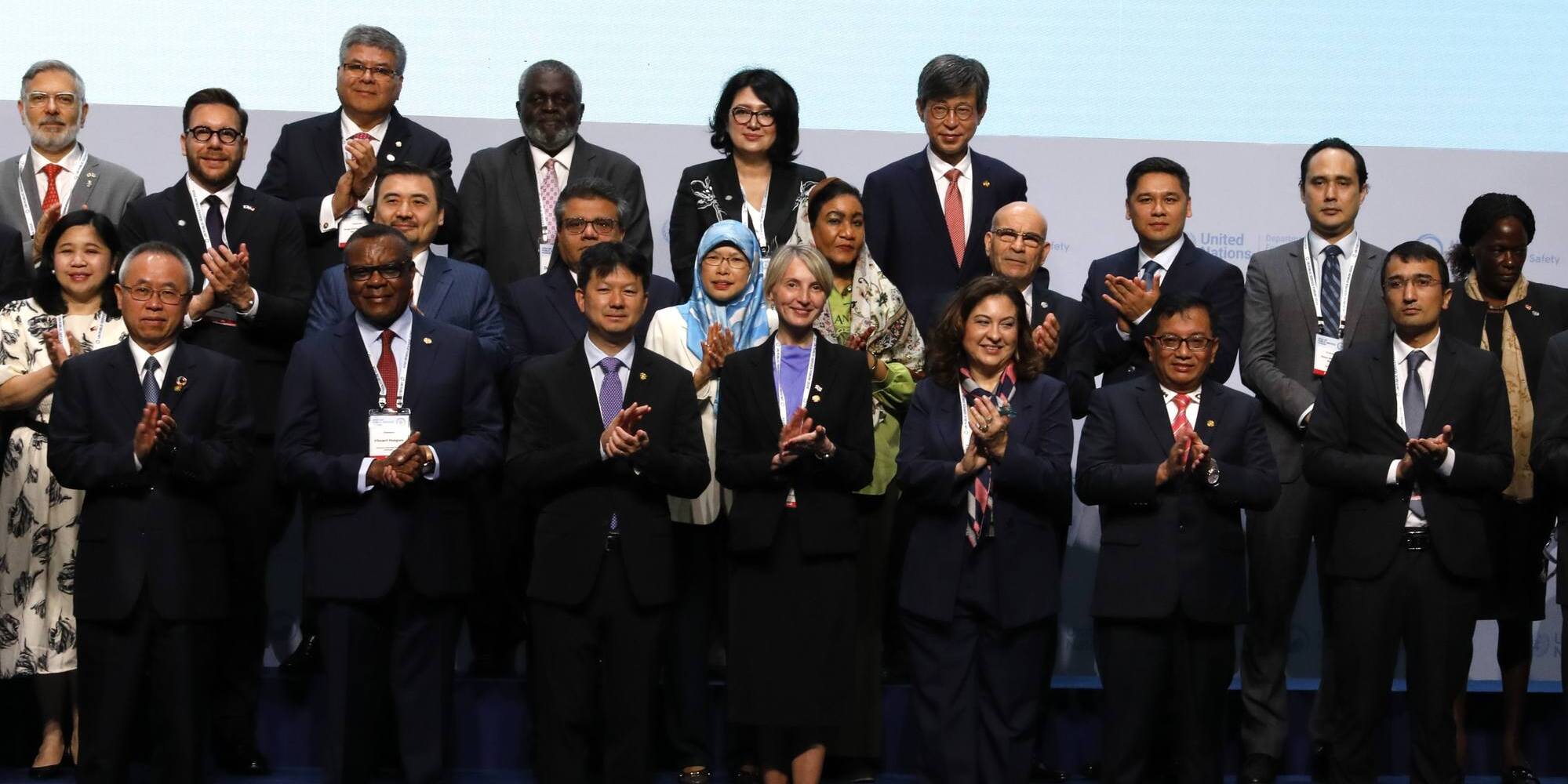
The annual World Public Service Forum, organized by the United Nations and the Ministry of Internal Affairs and Security of the Republic of Korea, commenced on June 24, 2024, in Incheon, South Korea. This year, the Georgian delegation, led by First Deputy Minister of Justice, Tamar Tkeshelashvili, is actively participating in the event.

The forum has brought together approximately 1,200 representatives from 50 countries. Key speakers at the opening ceremony included UN Under-Secretary-General for Economic and Social Affairs Lee Junhua, former UN Secretary-General Ban Ki-moon, President of the Republic of Korea Yoon Suk-yeol, and Minister of Internal Affairs and Security of the Republic of Korea Lee Sang-min. High-level government representatives, experts, and international organization members are also in attendance.

The annual UN Forum provides a vital platform for countries to discuss innovations, challenges, achievements, and future prospects in public service delivery. Georgian representatives will engage in various thematic sessions throughout the event. Additionally, First Deputy Minister of Justice Tamar Tkeshelashvili will deliver a speech at the ministerial round table meeting.

The Georgian delegation also includes: Georgia's Ambassador to the Republic of Korea, Tarash Papaskua, Chairperson of the Public Registry National Agency, David Devidze, Chairperson of the State Services Development Agency, Ketevan Betlemidze, Chairpperson of the Public Service Hall, Lasha Lobjanidze and Head of the International Relations Division of the Department of International Relations and Legal Cooperation of the Ministry ofJustice, Mariam Bregadze.

Notably, the Ministry of Justice of Georgia will host the World Public Service Forum in 2026, marking significant international recognition of Georgia's achievements in state service development. This initiative was discussed by the Minister of Justice of Georgia with the Deputy Secretary-General of the United Nations during a visit to the USA last year.

Other News

Share
Print
Share
Print

According to the Strasbourg Court, Publicly Made Insulting, Obscene, and Degrading Statements Fall Outside the Scope of Freedom of Expression

The European Court of Human Rights in Strasbourg upheld the position of the Ministry of Justice in the case of Miladze v. Georgia, confirming that publicly made insulting, obscene, and degrading statements directed at public officials are not protected under the right to freedom of expression.

The case concerned a video published on the social media platform TikTok in 2022, in which the applicant, civil activist Irakli Miladze, used obscene and insulting language toward the Mayor of Tbilisi, City Hall employees, and police officers. As a result, the national courts imposed a fine of 500 GEL, the minimum penalty provided for by law.

The Strasbourg Court unanimously held that the applicant’s statements did not amount to political criticism or the expression of views on a matter of public interest. According to the Court’s assessment, the language used was intended primarily to humiliate and insult public officials.

The Court also agreed with the reasoning of the national courts, noting that they had properly distinguished between harsh political criticism, which is protected in a democratic society, and personal insults, which are not. The judgment further emphasized that the sanction imposed on the applicant was minimal and proportionate, as he received only the lowest fine available under the law.

Today’s ruling by the Strasbourg Court reaffirmed an important principle: freedom of expression is one of the fundamental values of a democratic society and protects even strong and offensive criticism; however, it does not extend to humiliating or personally insulting statements directed at others, including public officials and civil servants.

The judgment further underscores that the state is entitled to protect political officials and public servants from unjustified verbal abuse and insults, ensuring that they are able to perform their duties in an environment free from attacks that undermine their dignity.

The Court’s assessment once again highlights the fundamental importance of freedom of expression, while clearly establishing that the exercise of this right — particularly on the internet and social media platforms — must not infringe upon the dignity and rights of others.