Hotline2 405 505

News

Friday, 16 February, 2024
Share

Embassy of the United States of America Supports Innovative Reforms of the Ministry of Justice

One of the priorities of the Ministry of Justice is rehabilitation and re-socialization of convicts and ex-prisoners. A number of state programs have been introduced to support prisoners. Their goal is to promote rehabilitation and re-socialization and, in this way, to protect the public from recidivism.

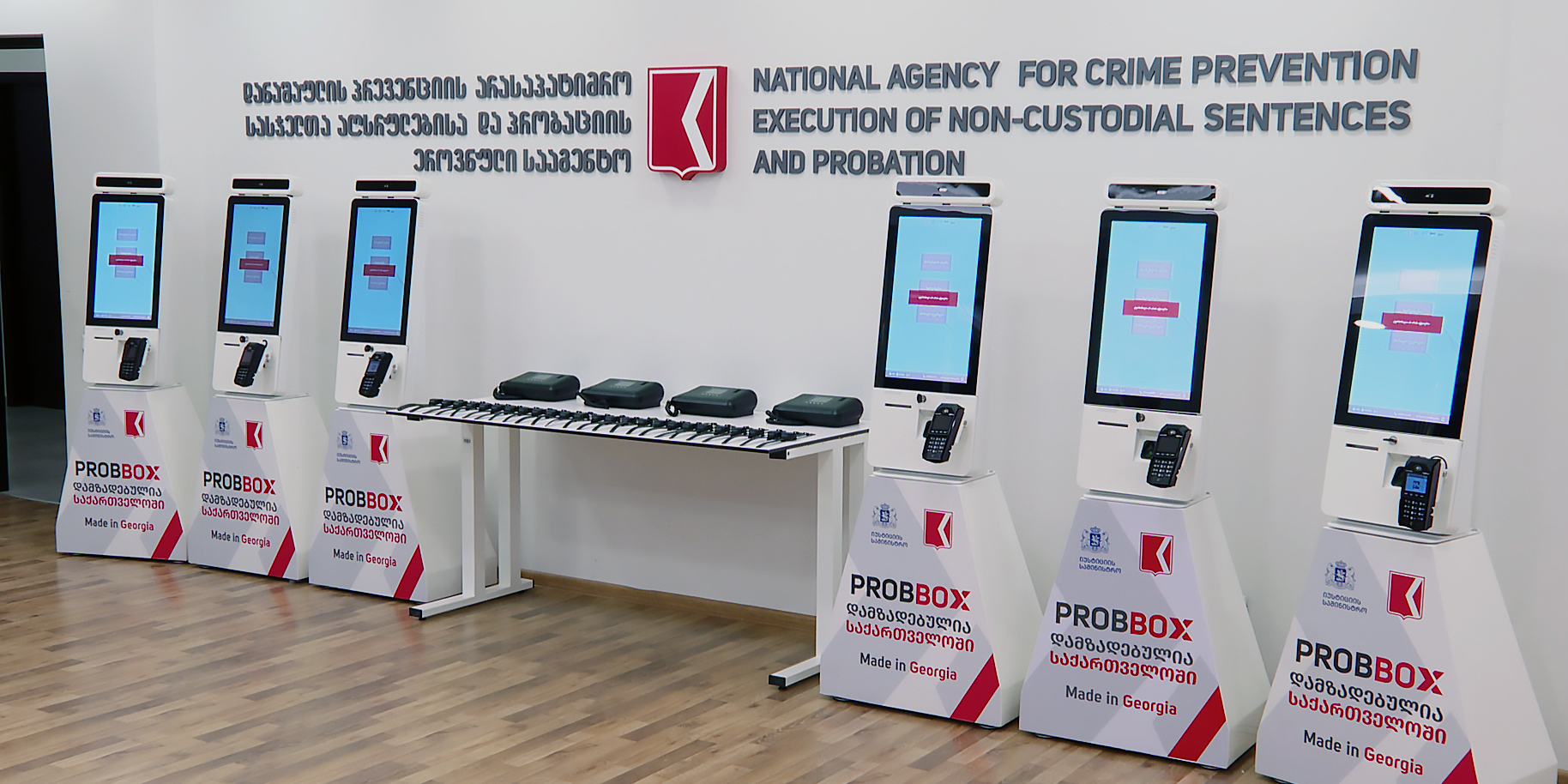
The Embassy of the United States of America gives the highest evaluation to the innovation project - PROBBOX created by the Ministry of Justice, which has no analogues in the world. The Ministry is also working on the export of the indicated project.

In cooperation with the Embassy of the United States of America, the area of access to services for probationers in Georgia has been further expanded. At this stage, 10 PROBBOX devices were installed in 10 locations across the country, increasing their total number to 27.

The Ministry of Justice will continue to increase access to innovative services for probationers in the future.

PROBBOX is the first innovative technological device in Europe that provides services and electronic control of probationers. With the help of this device, the registration and provision of services to probationers, in addition to reporting to the probation bureaus, is carried out in the public service halls and municipal buildings, thus ensuring greater anonymity of probationers and increasing the geographical area of probation coverage.

The embassy also handed over 50 electronic surveillance devices to the agency, which continuously monitors the location of convicts during the execution of house arrests, and the center for professional training and retraining of convicts received a vehicle and digital equipment as a gift for the distribution of agricultural products.

The event was attended by Deputy Minister of Justice, Buba Lomuashvili; Deputy Ambassador of the United States of America to Georgia, Alan Furcell and Director of the Bureau of Cooperation with State Anti-Narcotics and Law Enforcement Agencies of the United States of America, Sarah Rupert; As well as, Head of the National Agency for Crime Prevention, Enforcement of Non-custodial Sentences and Probation, Lado Kheladze; and Head of the Center for Vocational Training and Retraining of Convicts, Tamta Demurishvili.

Other News

Share
Print
Share
Print

According to the Strasbourg Court, Publicly Made Insulting, Obscene, and Degrading Statements Fall Outside the Scope of Freedom of Expression

The European Court of Human Rights in Strasbourg upheld the position of the Ministry of Justice in the case of Miladze v. Georgia, confirming that publicly made insulting, obscene, and degrading statements directed at public officials are not protected under the right to freedom of expression.

The case concerned a video published on the social media platform TikTok in 2022, in which the applicant, civil activist Irakli Miladze, used obscene and insulting language toward the Mayor of Tbilisi, City Hall employees, and police officers. As a result, the national courts imposed a fine of 500 GEL, the minimum penalty provided for by law.

The Strasbourg Court unanimously held that the applicant’s statements did not amount to political criticism or the expression of views on a matter of public interest. According to the Court’s assessment, the language used was intended primarily to humiliate and insult public officials.

The Court also agreed with the reasoning of the national courts, noting that they had properly distinguished between harsh political criticism, which is protected in a democratic society, and personal insults, which are not. The judgment further emphasized that the sanction imposed on the applicant was minimal and proportionate, as he received only the lowest fine available under the law.

Today’s ruling by the Strasbourg Court reaffirmed an important principle: freedom of expression is one of the fundamental values of a democratic society and protects even strong and offensive criticism; however, it does not extend to humiliating or personally insulting statements directed at others, including public officials and civil servants.

The judgment further underscores that the state is entitled to protect political officials and public servants from unjustified verbal abuse and insults, ensuring that they are able to perform their duties in an environment free from attacks that undermine their dignity.

The Court’s assessment once again highlights the fundamental importance of freedom of expression, while clearly establishing that the exercise of this right — particularly on the internet and social media platforms — must not infringe upon the dignity and rights of others.