Hotline2 405 505

News

Thursday, 16 May, 2024
Share

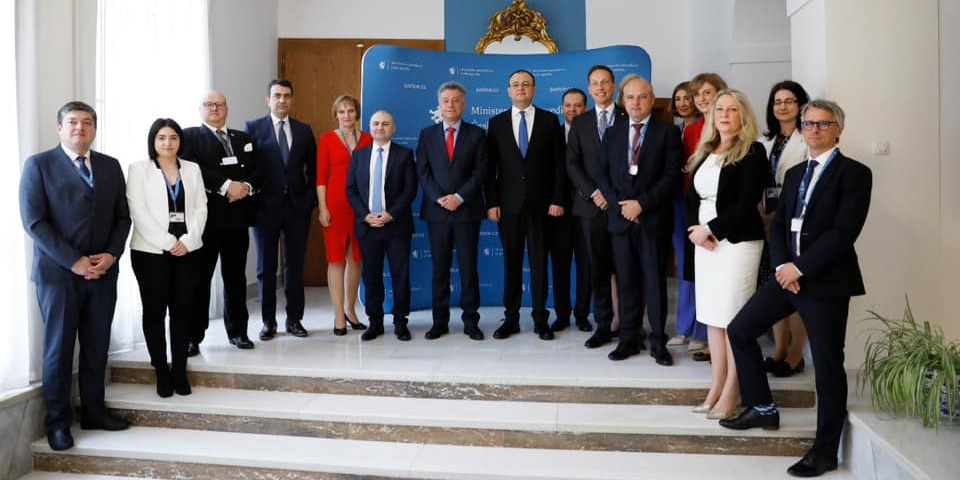
Czech-Georgian Legal Forum Held in Prague

The second annual Czech-Georgian legal forum was inaugurated by Justice Ministers Rati Bregadze and Pavel Blažek in Prague.

Minister Bregadze highlighted the importance and tradition of this bilateral forum, emphasizing its role in fostering sectoral cooperation between Georgia and the Czech Republic. He underscored its significance in Georgia's European integration process, which aligns with the country's historical aspirations.

The Czech-Georgian legal forum serves as an excellent platform for strengthening the legal systems of both nations, both institutionally and substantively. It facilitates deeper cooperation, experience sharing, and discussion of specific initiatives among the justice ministries of Georgia and the Czech Republic, legal professionals, and judicial representatives.

The forum includes sessions on various critical topics, such as mechanisms for human rights protection and the enforcement of international court decisions; the harmonization of national legislation with EU laws; the continuous training of penitentiary and probation system employees; justice system reforms aimed at enhancing efficiency; the role of lawyers in human rights protection; and the importance of diversion and mediation in criminal law.

Deputy Ministers of Justice of Georgia, Beka Dzamashvili and Tornike Cheishvili, are participating in the forum, along with representatives from the Bar Association, Legal Aid Service, and the Court System.

The concept of the Czech-Georgian legal forum was conceived in October 2022 during a meeting between the justice ministers of the two countries. The event will alternate hosting duties between Tbilisi and Prague.

Other News

Share
Print
Share
Print

According to the Strasbourg Court, Publicly Made Insulting, Obscene, and Degrading Statements Fall Outside the Scope of Freedom of Expression

The European Court of Human Rights in Strasbourg upheld the position of the Ministry of Justice in the case of Miladze v. Georgia, confirming that publicly made insulting, obscene, and degrading statements directed at public officials are not protected under the right to freedom of expression.

The case concerned a video published on the social media platform TikTok in 2022, in which the applicant, civil activist Irakli Miladze, used obscene and insulting language toward the Mayor of Tbilisi, City Hall employees, and police officers. As a result, the national courts imposed a fine of 500 GEL, the minimum penalty provided for by law.

The Strasbourg Court unanimously held that the applicant’s statements did not amount to political criticism or the expression of views on a matter of public interest. According to the Court’s assessment, the language used was intended primarily to humiliate and insult public officials.

The Court also agreed with the reasoning of the national courts, noting that they had properly distinguished between harsh political criticism, which is protected in a democratic society, and personal insults, which are not. The judgment further emphasized that the sanction imposed on the applicant was minimal and proportionate, as he received only the lowest fine available under the law.

Today’s ruling by the Strasbourg Court reaffirmed an important principle: freedom of expression is one of the fundamental values of a democratic society and protects even strong and offensive criticism; however, it does not extend to humiliating or personally insulting statements directed at others, including public officials and civil servants.

The judgment further underscores that the state is entitled to protect political officials and public servants from unjustified verbal abuse and insults, ensuring that they are able to perform their duties in an environment free from attacks that undermine their dignity.

The Court’s assessment once again highlights the fundamental importance of freedom of expression, while clearly establishing that the exercise of this right — particularly on the internet and social media platforms — must not infringe upon the dignity and rights of others.