Hotline2 405 505

News

Thursday, 02 February, 2023
Share

Ministry of Justice Will Share Germany's Best Practices in Notary Activities

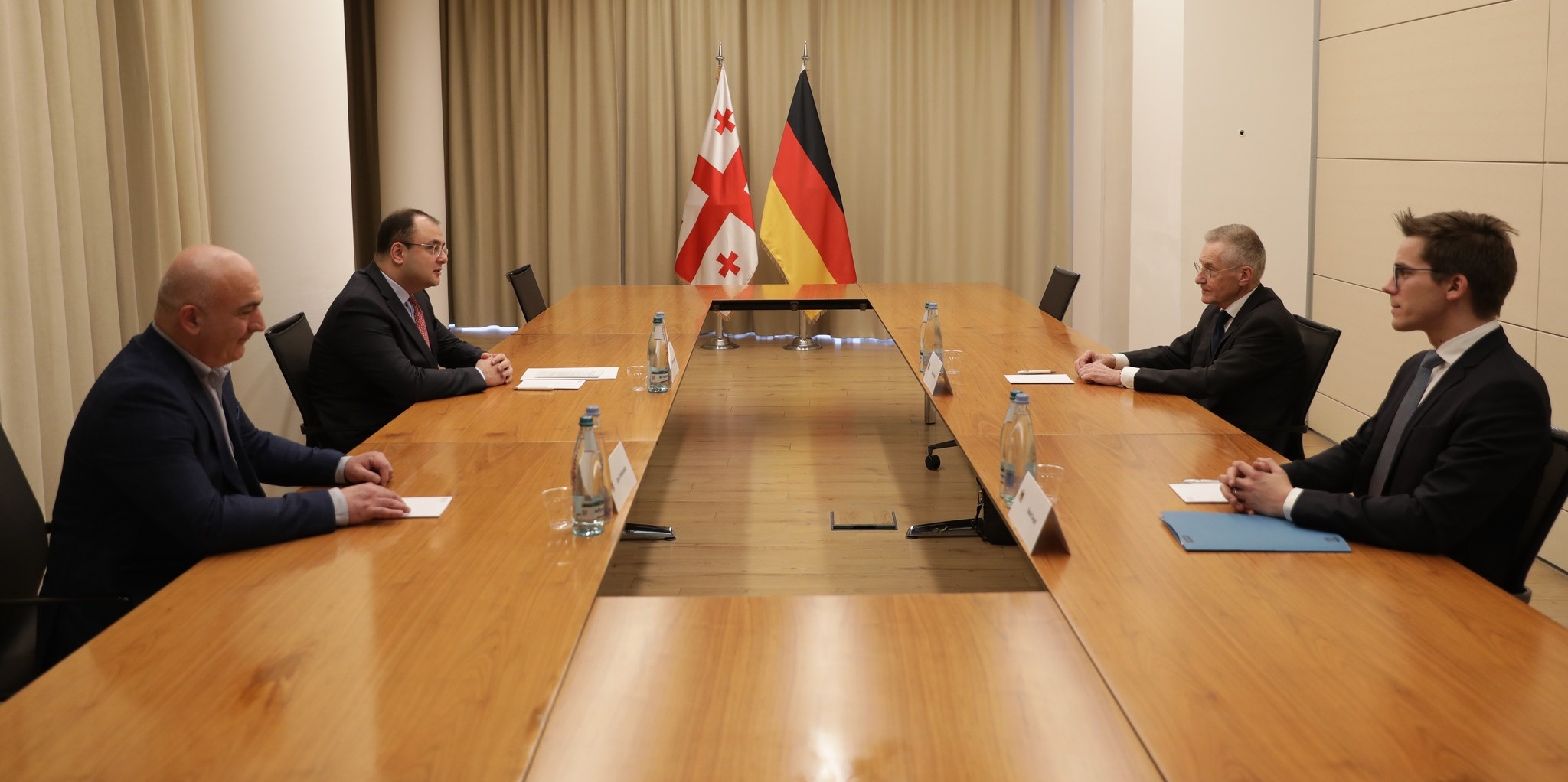
Minister of Justice, Rati Bregadze held a meeting today with Head of the Chamber of Notaries of the Federal Republic of Germany, Richard Bock.

Rati Bregadze and Richard Bock talked about the measures to be implemented in the direction of the development of notary law, within the framework of which joint educational events and trainings of Georgian-German notaries will be planned.

At the meeting, the Minister of Justice noted that the Chamber of Notaries of Georgia is a member of the International Union of Notaries and constantly takes care of its development. The agency responds to modern challenges and requirements, the result of which is the electronic registry of notarial acts operating in Georgia. Citizens receive remote services through electronic communication, and these methods are improving in the wake of the development of modern technological capabilities.

According to the Minister, the Ministry of Justice works intensively for the development of the capabilities of the Chamber of Notaries and the notaries themselves. One of the priority directions is the introduction of modern technologies in order to further simplify the process of notaries' activities and to raise the level of their service provision. In this regard, the issue of improving online and remote performance of notarial actions is particularly relevant.

While talking to Richard Bock, Rati Bregadze was interested in the issue of digitalization and preparation of electronic legal transactions.

At the end of the meeting, the Minister of Justice told the Head of the Chamber of Notaries of the Federal Republic of Germany that he plans to share the best practices of German notaries and legal specialists in this matter.

Other News

Share
Print

According to the Strasbourg Court, Publicly Made Insulting, Obscene, and Degrading Statements Fall Outside the Scope of Freedom of Expression

The European Court of Human Rights in Strasbourg upheld the position of the Ministry of Justice in the case of Miladze v. Georgia, confirming that publicly made insulting, obscene, and degrading statements directed at public officials are not protected under the right to freedom of expression.

The case concerned a video published on the social media platform TikTok in 2022, in which the applicant, civil activist Irakli Miladze, used obscene and insulting language toward the Mayor of Tbilisi, City Hall employees, and police officers. As a result, the national courts imposed a fine of 500 GEL, the minimum penalty provided for by law.

The Strasbourg Court unanimously held that the applicant’s statements did not amount to political criticism or the expression of views on a matter of public interest. According to the Court’s assessment, the language used was intended primarily to humiliate and insult public officials.

The Court also agreed with the reasoning of the national courts, noting that they had properly distinguished between harsh political criticism, which is protected in a democratic society, and personal insults, which are not. The judgment further emphasized that the sanction imposed on the applicant was minimal and proportionate, as he received only the lowest fine available under the law.

Today’s ruling by the Strasbourg Court reaffirmed an important principle: freedom of expression is one of the fundamental values of a democratic society and protects even strong and offensive criticism; however, it does not extend to humiliating or personally insulting statements directed at others, including public officials and civil servants.

The judgment further underscores that the state is entitled to protect political officials and public servants from unjustified verbal abuse and insults, ensuring that they are able to perform their duties in an environment free from attacks that undermine their dignity.

The Court’s assessment once again highlights the fundamental importance of freedom of expression, while clearly establishing that the exercise of this right — particularly on the internet and social media platforms — must not infringe upon the dignity and rights of others.